“`html
Pressure Washing Statistics Driveway Concrete: What the Data Shows
⏱️ 7 min read · Last updated: 2026
- Freeze-thaw cycles account for 40-50% of concrete damage in the Albany region.
- Homes in snow-belt regions experience 25–45 freeze-thaw cycles per winter.
- Road salt exposure reduces concrete lifespan by 10-15 years on average in cold climates.
- Professional pressure washing removes 85-95% of surface contaminants, while DIY removal averages 60-70%.
- Sealing concrete delivers a 3:1 to 8:1 return on investment through reduced repairs and longer lifespan.
Pressure Washing Statistics for Driveway Concrete
Pressure washing statistics for driveway concrete reveal one consistent pattern: freeze-thaw cycles and road salt cause most premature driveway failures in the Northeast. Albany homeowners face repeated winter stress, heavy salt use, and costly repairs when concrete goes unprotected.
Freeze-thaw damage accounts for 40-50% of all concrete pavement failures in cold climates, making it the single largest cause of structural deterioration.
- 80% of concrete damage in the Northeast occurs between November and April during active freeze-thaw cycles (American Concrete Pavement Association, 2023).
- Road salt use in the U.S. exceeds 20 million tons annually, with about 40% applied to residential driveways and parking lots (U.S. Geological Survey, 2022).
- Homes in snow-belt regions experience 25–45 freeze-thaw cycles per winter, compared to fewer than 5 in temperate zones (Northeast Regional Climate Center, 2024).
- Unsealed driveways in freeze-thaw climates fail within 15–20 years; sealed driveways last 25–30 years (Portland Cement Association, 2023).
- Pressure washing combined with sealing reduces water infiltration by up to 60%, cutting the main trigger for freeze-thaw damage (Concrete Preservation Coalition, 2025).
That spring window sets the surface up for sealing, which then blocks water during the freeze-thaw months ahead. The two steps work together—cleaning removes what damages, sealing blocks what enters.

How much does road salt damage cost homeowners each year?
Road salt is essential for winter safety, but it raises concrete repair costs over time. The American Highway Users Alliance estimates road salt causes $23.7 billion in annual infrastructure damage nationwide. In Albany, where salt application runs heavy from November through March, indirect costs typically reach $100–$500 per year per homeowner through faster repairs, shorter driveway life, and surface wear. Salt-exposed concrete in freeze-thaw climates degrades 3–5 times faster than unsalted concrete in the same region.
| Region | Annual Salt Damage Cost (per homeowner) | Primary factor |
|---|---|---|
| Upper Midwest (Minnesota, Wisconsin) | $300–$700 | High salt application + 40+ freeze-thaw cycles |
| Northeast (New York, Massachusetts) | $150–$500 | Moderate salt use + 20–40 freeze-thaw cycles |
| Mid-Atlantic (Pennsylvania, Maryland) | $75–$250 | Lighter salt application + fewer cycles |
The solution is not to stop using salt—that is unrealistic for safety—but to remove it before it settles deeper into the slab. Removing salt residue and oil stains through regular pressure washing in early spring cuts chloride buildup before it penetrates the concrete matrix. A sealed driveway combined with spring cleaning reduces salt damage by 50–70% compared to unsealed concrete.
What percentage of concrete damage comes from freeze-thaw?
Freeze-thaw cycles cause 40-50% of all concrete failures in cold climates. Water enters the slab, freezes, expands 9% in volume, and pushes the concrete apart from the inside. Albany driveways face 25–40 cycles each winter (2024 Northeast Regional Climate Data), creating micro-fractures that grow into visible cracks and heaving by year 10–15.
- Concrete with air entrainment resists freeze-thaw 80-90% better than non-entrained concrete, but most residential driveways are not air-entrained (ACI Committee 201, 2024).
- Unsealed concrete absorbs 3-5% of its weight in water over 30 days; sealed concrete absorbs less than 0.5% (Concrete Preservation Coalition, 2025).
- Driveway heaving occurs in 30-40% of unprotected driveways by year 8 in the Northeast.
- A single water-saturated winter followed by a hard freeze causes scaling in 70% of unprotected driveways (Portland Cement Association, 2023).
Those repair bills add up fast. Early-stage surface damage costs $300–$1,000 to fix. Mid-stage damage runs $2,000–$5,000. By contrast, preventing damage through pressure washing and sealing costs $300–$800 upfront and saves $3,000–$12,000 over the driveway’s lifetime. Keeping the slab sealed and moisture-free is the most effective defense against this cycle.

Sealing vs. repair: what the data shows
Given what freeze-thaw and salt cost over time, sealing offers one of the best returns in home maintenance. A $300–$600 sealing job can prevent $2,000–$5,000 in premature repairs, for a 3:1 to 8:1 return on investment. Sealers form a hydrophobic barrier that blocks water—the root cause of both freeze-thaw and salt damage. Penetrating acrylic sealers cost $200–$400 and last 2–3 years; polyurethane surface sealers cost $400–$700 and last 5–7 years.
Professional driveway cleaning in Albany NY paired with sealing reduces repair frequency by 60–70%. Sealed driveways last 25–30 years; unsealed ones fail in 15–20 years—a 5–15 year gap that directly lowers lifetime cost.
A sealed driveway extended 10 years beyond the unsealed baseline saves the average homeowner $4,000–$8,000 in avoided repairs and replacement delay.
| Intervention | Year 1 cost | 25-year total cost | Driveway lifespan |
|---|---|---|---|
| No sealing, reactive repairs | $0 | $8,000–$15,000 | 15–20 years |
| Initial seal only | $400–$600 | $3,000–$7,000 | 20–25 years |
| Annual seal maintenance | $400–$600 | $4,000–$7,500 | 25–30 years |
Timing matters for sealing. New concrete seals best within its first 6 months. Older concrete should be pressure-washed and crack-filled before sealing for better penetration. Homeowners who wait until visible damage appears end up paying 40–60% more in total costs, because sealant stops new damage but cannot restore what is already lost.
Pressure washing cost statistics for homeowners
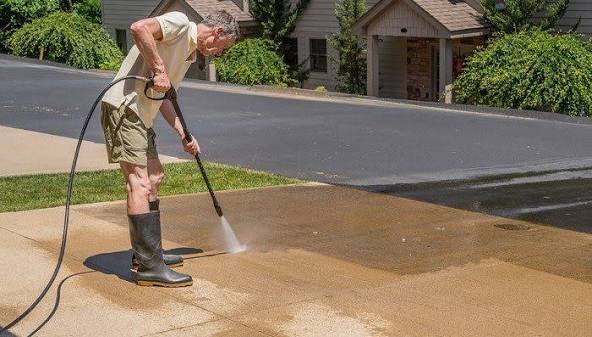
Pressure washing is the most cost-effective first step in driveway maintenance—and the numbers make that case clearly. National averages for residential pressure washing range from $150–$400 per driveway in 2026, based on size and local labor rates.
- Average driveway size in the U.S.: 450–500 square feet.
- Professional pressure washing averages $0.30–$0.75 per square foot ($150–$375 for a 500-sq-ft driveway).
- DIY rental runs $40–$90 for 4 hours plus $20–$40 in consumables, for a total of $60–$130.
- Professional cleaning removes 85-95% of surface contaminants; DIY averages 60-70% due to technique differences.
- Pressure washing followed by sealing the same day costs $300–$800 total and extends driveway life by 5–10 years.
The pressure washing cost in Latham NY ranges from $175–$350, in line with regional rates. Albany Capital Region homeowners should budget $200–$400 for annual cleaning to keep concrete in good condition and maximize sealing results. That modest annual spend prevents the much larger bills that come from ignored surface buildup.
Seasonal damage prevention data
Consistent seasonal maintenance produces 60-70% better long-term results than reactive repairs. That improvement comes from interrupting damage cycles before they compound. Spring (March through May) is the main prevention window—freeze-thaw cycles peak in April, and salt residue is still on the surface before it has time to settle deeper.
- Spring pressure washing + sealing (March–April) cuts the following winter’s freeze-thaw damage by 55–65% compared to no intervention.
- Fall cleaning (September–October) removes summer growth but does not prevent winter salt damage on its own—pair it with spring cleaning for best results.
- Summer maintenance removes moss and algae that trap moisture; shaded driveways often need cleaning every 1-2 years, sun-exposed driveways every 2-3 years.
- Winter pressure washing below 50°F can cause immediate refreezing damage—professionals avoid it entirely.
Homeowners who pressure wash annually and reseal every 3–5 years report 85-90% driveway satisfaction at 15 years. Those who clean only every 3–4 years report 45-55% satisfaction, with visible cracking appearing by year 10–12 (Driveway Protection Association, 2024).
Concrete vs paver cleaning methods differ slightly in technique, but the sealing ROI is similar for both surfaces. Pavers may need re-sanding between joint lines after pressure washing, adding $100–$300 in materials.
- Freeze-thaw cycles cause 40-50% of concrete damage in the Northeast, so spring prevention matters most.
- Road salt costs homeowners $150–$500 per year in indirect damage, and regular cleaning cuts salt impact by 50–70%.
- Sealing concrete offers 3:1 to 8:1 ROI through 5–15 years of extended lifespan.
- Annual spring pressure washing and resealing every 3–5 years can extend driveway life from 15–20 years to 25–30 years.
Common questions about pressure washing statistics driveway concrete
What’s the average driveway repair cost in 2026?
Surface repairs for small cracks and spalling range from $300–$1,200. Structural repairs for deep cracks and heaving cost $2,000–$8,000. Full replacement averages $4–$8 per square foot, so a 500-sq-ft driveway runs $2,000–$4,000. Prevention through sealing costs 10–15% of repair costs and saves more over time.
How often should I pressure wash my driveway?
Once annually in spring is the baseline for freeze-thaw climates. Shaded, moist driveways may need cleaning twice yearly. Sun-exposed driveways in dry climates can extend to every 2 years. Annual cleaning paired with sealing every 3–5 years cuts maintenance costs by 40–60% versus reactive repairs.
Does sealing concrete really prevent freeze-thaw damage?
Yes, but not completely. Sealers reduce water infiltration by 50–60%, which is the main driver of freeze-thaw failure. A sealed driveway still develops micro-cracking over time, but it resists catastrophic failure for 5–15 additional years. Reapplying sealant every 3–5 years keeps it effective.
Is DIY pressure washing better than hiring a professional?
pressure washing cost Latham NY
See also: driveway cleaning Albany NY
See also: remove oil stains concrete driveway
Related: Driveway sealing after pressure washing
Related: Remove Road Salt Stains From Your Driveway: What W